
'When we start describing somebody as an enemy that is the start of politics and emotion after which no business can take place.' 'We need to get out of this, allow Indian businessmen to do business with China.'

Bank of Baroda economists project India's GDP to grow 6.5-6.8 per cent in FY27 but warn that the fiscal deficit could overshoot the budgeted 4.3 per cent target, potentially reaching 4.7-4.8 per cent of GDP due to subsidy overruns, excise duty cuts, and oil marketing company losses.

Chief Economic Advisor V Anantha Nageswaran stated that India's economy is projected to return to a 7 per cent-plus growth trajectory by 2027-28 (FY28), or sooner if external conditions improve, despite near-term challenges from the West Asia crisis.

Male central government employees are entitled to 15 days under service rules and provisions in the private sector depends on the company's policy.

The Indian banking system's net liquidity surplus has reached a four-year high of Rs 4.57 trillion, driven by maturing government securities, with further maturities expected to push the surplus to around 5 trillion.
India Ratings and Research predicts the Reserve Bank of India (RBI) will maintain the repo rate at 5.25 per cent throughout FY27, despite potential inflationary pressures from higher fuel prices, with inflation expected to remain within the central bank's tolerance band.

Why would a country that requires close to $90 billion in net foreign capital annually to create jobs, build productive capacity, and sustain rapid growth permit $30 billion of capital to flow abroad, thereby contributing to pressure on the rupee? asks Debashis Basu.

The central bank is yet to consider actions such as a rate hike or mobilising dollar inflows from non-resident Indians to boost forex reserves as it cannot afford to continue with them for long when the rupee's internationalisation tops its agenda, explains Tamal Bandyopadhyay.

'...A new challenge has emerged in the form of Mythos.'

Vinesh Phogat, despite losing in the Asian Games selection trials, asserts her return to wrestling after motherhood as a victory, aiming for the 2028 Los Angeles Olympics while criticising the wrestling administration for alleged discrimination and harassment.

Congress leader Shashi Tharoor criticised the proposal to increase the Lok Sabha's strength to 850, while BJP leaders defended delimitation as a democratic necessity at the Stanford India Conference 2026.

While opening new accounts, banks can check if the name appears in any mule data. In case it does, the bank can conduct enhanced due diligence.

India's retail inflation, measured by the Consumer Price Index (CPI), increased to 3.48 per cent in April, up from 3.40 per cent in March, primarily due to a surge in prices of gold and silver jewellery, as well as certain kitchen staples like tomatoes and cauliflower.

Foreign Portfolio Investors (FPIs) have withdrawn nearly Rs 43,000 crore from Indian equities in the first week of June, contributing to a total outflow of Rs 2.67 lakh crore in 2026, driven by a global shift towards technology and AI-linked opportunities and persistent rupee depreciation.

Prime Minister Narendra Modi asserted that the TMC's governance in West Bengal is nearing its end, citing corruption and unfulfilled promises. He highlighted the BJP's commitment to development and security, particularly for the fisherfolk and against infiltration.

Ideology is dead; long live the numbers game that is being played with the sole intention of securing a two-third majority in the Lok Sabha for the NDA, observes Nilanjan Mukhopadhyay.

The Reserve Bank of India (RBI) Governor Sanjay Malhotra is now confronting the classic growth-inflation tradeoff, a situation exacerbated by the West Asia war, which threatens to end the 'goldilocks period' of low inflation and robust growth.

The Reserve Bank of India (RBI) has opted to keep its key interest rates unchanged at 5.25%, anticipating a global economic recovery following a ceasefire in the US/Israel-Iran conflict, despite ongoing inflationary pressures and currency fluctuations.
The Indian rupee rebounded 50 paise from its all-time closing low to settle at 96.36 against the US dollar, driven by retreating crude oil prices, signs of easing geopolitical friction, and likely central bank intervention.

The Supreme Court on Thursday held that the Governor can reserve a bill for consideration of the President even in the second instance, when the bill is again sent by the state assembly to him whether in its amended or unamended form.

Students at Delhi University's Lady Shri Ram (LSR) College have issued a statement clarifying their recent protest, asserting it is not biased against any political ideology. This comes as the college principal, Kanika K Ahuja, addresses the situation and ongoing dialogue between students and the administration.

Prime Minister Narendra Modi criticised the Mamata Banerjee government in West Bengal, promising development, accountability, and an end to corruption if the BJP wins the upcoming assembly elections.

Crude oil prices surged over 3% in futures trade after US President Donald Trump expressed doubts about the Iran ceasefire, reigniting fears of supply disruptions from West Asia and pushing Brent crude above USD 107 per barrel.

Reserve Bank of India (RBI) Governor Sanjay Malhotra stated that recent regulatory measures to address foreign exchange market volatility, such as capping banks' net open positions, are temporary and aligned with current market conditions, not signalling any structural shift in policy.

Prime Minister Narendra Modi addressed the BJP's 47th Foundation Day, highlighting the Uniform Civil Code and 'One Nation, One Election' as key unfinished agendas. He also reaffirmed the party's commitment to implementing women's reservation in the 2029 elections and criticised dynastic politics.

Gold prices are expected to maintain their upward momentum though some consolidation could set in ahead of the US Federal Reserve's policy decision on September 17, analysts said. Traders will focus on the trade inflation data to gauge the impact of tariffs, inflation numbers from major economies including UK and Euro zone, along with monetary policy meetings of Bank of England and Bank of Japan which will provide more guidance for bullion prices, they added.
Uncertainties stemming from the West Asia crisis and its potential impact on inflation and economic growth were key factors in the Reserve Bank of India's Monetary Policy Committee (MPC) decision to maintain the status quo on interest rates, according to the recently released MPC meeting minutes.
Prime Minister Narendra Modi announced six guarantees for West Bengal if the BJP wins the Assembly polls, criticising the TMC government and promising development and accountability.

The Indian rupee saw a significant appreciation against the US dollar following President Trump's suspension of military strikes against Iran and the Reserve Bank of India's decision to maintain its key interest rate. Market sentiment was further buoyed by positive comments from the RBI regarding the health of the banking sector.
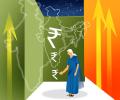
The World Bank has affirmed India's strong position to withstand the current global energy shock, citing high foreign exchange reserves, fiscal space, and low inflation as key buffers supporting continued growth despite international headwinds.

A parliamentary panel has decided to review the implementation of reforms in the National Testing Agency (NTA) as well as the NEET-UG 2026 paper leak case and has summoned NTA Chairperson Pradeep Kumar Joshi and other bureaucrats for deliberations.

The measures announced by it risk backfiring, disrupting the foreign exchange market, and intensifying the very pressures they seek to contain, with broader consequences for the economy points out Rajeswari Sengupta.

"It is quite possible that the rates will remain low in the near to medium term, but that will depend on how conditions evolve," said RBI Governor Sanjay Malhotra.

Even if the Reserve Bank of India's Monetary Policy Committee decided to hold interest rates in the October meeting, it acknowledged the scope for further rate cuts while waiting for the impact of the past steps to play out.

The Sri Lankan government attributes the sharp depreciation of the rupee against the US dollar to the ongoing conflict in West Asia, citing increased costs for essential imports like gas, fertiliser, and oil.

The University of Chicago has conferred its Alumni Award for Professional Achievement to India's former chief economic adviser Krishnamurthy V Subramanian, the first Indian economist to receive the honour since 1941.

The Rajasthan High Court has revised its transgender reservation judgment, reaffirming the constitutional right to self-identify gender while addressing concerns about the 2026 Amendment Act's impact on transgender rights.

India's gross savings rate is projected to be nearly 47 basis points higher in FY25 than previously estimated, following the Securities and Exchange Board of India's (Sebi) revision of the methodology for calculating household savings routed through the securities market.

The Supreme Court granted interim bail to two Delhi riots accused, while addressing concerns about conflicting views on bail under the Unlawful Activities Prevention Act (UAPA). The court referred the question of law on whether prolonged incarceration can override UAPA restrictions to a larger bench.

The consumer price index (CPI)-based inflation hitting an all-time low in October would encourage the six-member monetary policy committee (MPC) of the Reserve Bank of India (RBI) to cut the policy repo rate in its upcoming December 3-5 meeting. However, the July-September GDP growth, expected to be above 7 per cent, may act as a deterrent.
